
Union Home Minister Amit Shah Dedicates Azadi ki Pehli Ladai (1857) ka Shaheed Smarak to the Nation in Ambala


Azadi ki Pehli Ladai (1857) ka Shaheed Smarak to Preserve the Legacy of 1857 Revolutionaries and Inspire Future Generations with Their Valour and Patriotism
Chandigarh,
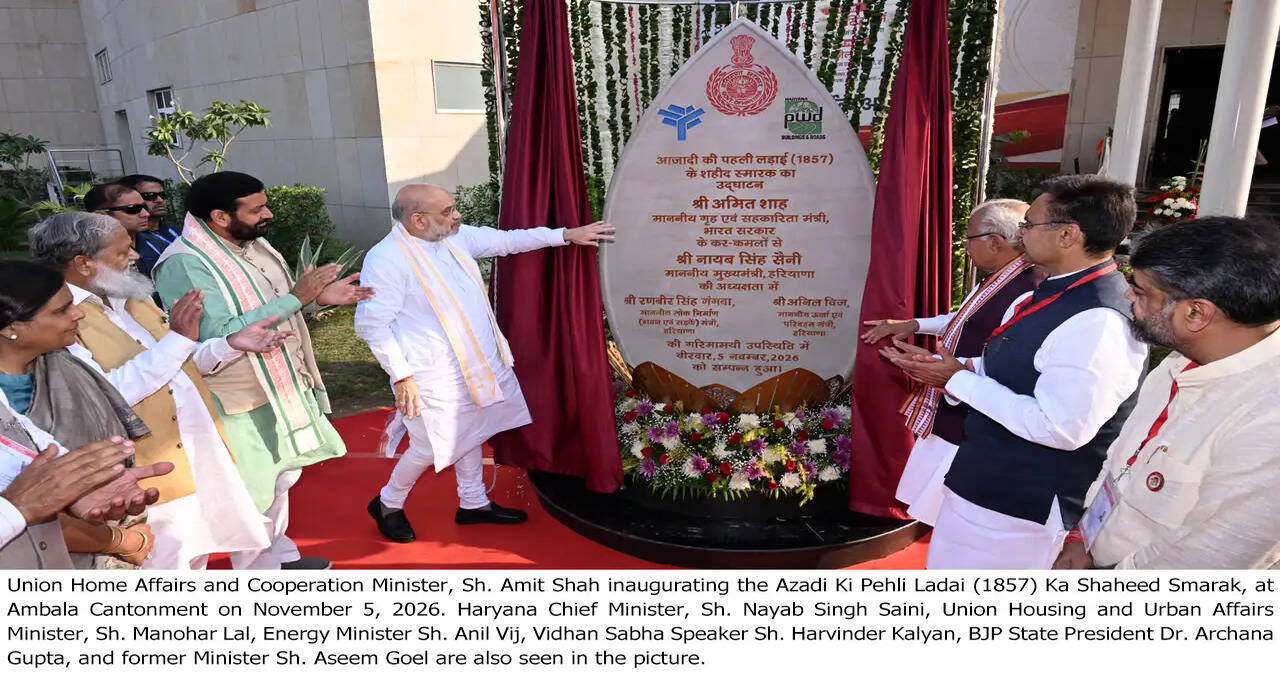
The valour, sacrifice and indomitable spirit of the revolutionaries who fought India’s First War of Independence in 1857 have found an enduring tribute in Ambala. Union Home and Cooperation Minister Sh. Amit Shah on Thursday dedicated Azadi ki Pehli Ladai (1857) ka Shaheed Smarak to the nation, marking a significant occasion in preserving the legacy of the freedom fighters whose courage and patriotism helped shape India’s struggle for independence.
The grand Shaheed Smarak stands as a tribute to the heroes of 1857, whose extraordinary courage, struggle and sacrifice remain an enduring source of national pride. By keeping their inspiring legacy alive, Azadi ki Pehli Ladai (1857) ka Shaheed Smarak will acquaint future generations with the spirit of patriotism and the sacrifices made in the pursuit of India's freedom. Haryana Chief Minister Sh. Nayab Singh Saini, Union Minister of Power Sh. Manohar Lal, and Haryana Transport Minister and Ambala MLA Sh. Anil Vij were also present on the occasion.
The inauguration began with a message of environmental responsibility as Union Home and Cooperation Minister Sh. Amit Shah and Chief Minister Sh. Nayab Singh Saini planted saplings on the premises under the Ek Ped Maa Ke Naam campaign, highlighting the importance of environmental conservation. The dignitaries subsequently lit the ceremonial lamp to formally commence the inaugural programme.
The Union Home Minister viewed an introductory virtual reality film showcasing the museum and its exhibits. He also explored the telegram exhibition depicting the beginning of the 1857 uprising in Ambala and its spread across Haryana. A puppet show portraying the uprising in Haryana offered another engaging glimpse into the historic struggle, bringing the events and spirit of the revolutionary movement to life.The dignitaries also paid tributes to the brave revolutionaries of 1857, honouring their courage, sacrifice and unwavering dedication to the nation.
Azadi ki Pehli Ladai (1857) ka Shaheed Smarak
The First War of Independence in 1857 was far more than a military revolt. It was a powerful and widespread call for freedom that shook the very foundations of British rule in India. In this historic struggle, legendary figures such as Rao Tula Ram, Mangal Pandey, Rani Lakshmibai, Nana Saheb and Tatya Tope emerged as prominent leaders, displaying extraordinary courage and giving direction and momentum to the struggle for independence. Amidst the flames of this great revolution brave heroes of Haryana also emerged, whose stories continue to inspire generations.
This First War of Independence instilled a deep sense of nationalism and patriotism in the Indian psyche, which later became the foundation of the entire freedom movement. To preserve the memory of this extraordinary courage and sacrifice, the ‘Azadi ki Pehli Ladai ka Shaheed Smarak’ is being created as a lasting tribute to those who gave everything for the cause of freedom.
This museum is India's largest upcoming museum on the freedom struggle, developed not merely as a building complex, but as a site of national pilgrimage. The entire complex of this memorial is spread over a vast expanse of 22 acres, where every brick and every wall is steeped in the spirit of patriotism. The main museum, situated at the center of this complex, is divided into three floors, within which 22 unique galleries have been constructed in a highly meticulous and well-researched manner. This museum does not merely serve dry historical information to its visitors; rather, through a confluence of architecture, art, and cutting-edge technology, it completely resurrects the past. With welcoming facilities like ticketing, orientation room, and an attractive lotus canopy, this place draws visitors directly into the turbulent era of 1857.
The museum’s galleries unfold as a chronological and immersive journey through the events of 1857. The experience begins with the Orientation and Parichay galleries, guiding the visitors about their upcoming journey and introducing them about the history of Haryana. Visitors then enter the Arrival of the British gallery, which explores how foreign powers gradually disrupted the foundations of India. Through the evocative use of traditional Phulkari craft of Haryana, the gallery contrasts this period of change with glimpses of India’s earlier cultural and economic prosperity.
The journey continues into the Causes of the Revolution gallery, which examines the growing discontent that spread across different sections of society. Through intricate metal-craft artwork and a lifelike holographic multimedia presentation, visitors encounter the story of the greased cartridges, the immediate spark that intensified the growing unrest and helped ignite the revolution.
The revolution was not an overnight event; it was backed by deep and subtle strategy. This becomes very evident in the Planning of the Revolution gallery. It is showcased here how the revolutionaries decided to use the severe heat of North India as a natural weapon against the British, selecting May 10 as the day for the uprising. The gallery uses Haryana’s traditional Sarkanda craft to invite visitors to decode the secret and silent symbols of the revolution, like methods of communication used to spread the message and prepare people for the struggle. These included peeling tree bark to convey the cruelty of British rule, distributing chapatis to signal villages to prepare for the coming revolution, and exchanging lotus flowers to rally the support of sepoys in the cantonments. The journey then moves to Ambala – A Strategic Location, where the geographical and strategic significance of the Ambala Cantonment is brought to life through an engaging kinetic table projection.
The following Events at Ambala gallery presents authentic historical documentation of the growing unrest in the region. Even before the formal outbreak of the revolution, secret acts of arson and mounting resistance against British rule had intensified across Ambala during the months of March and April 1857. Then the journey moves on to the Outbreak at Ambala gallery recreates a British Telegraph Office, featuring the historic telegram that bears witness to the fact that Ambala rose up against the British on the morning of 10th May 1857, 9 hours before the outbreak at Meerut on the same day. An interactive Morse code experience brings the telegraph communication technology of the time to life.
In the War at Ambala gallery, traditional wood carving art immortalizes the first historic struggle initiated by the 60th and 5th Native Infantry in Ambala on May 10. The entire story of this important event is told with an immersive projection show in the gallery. This revolution soon engulfed the entire region. The Outbreak at Haryana, Revolution in Haryana, and Battles of Haryana galleries use Augmented Reality (AR), Virtual Reality (VR), and interactive projections to vividly depict how fierce and difficult battles were fought against the British in the villages and cities of Haryana.
A puppet show accompanied by a poetic presentation also presents the local stories of the struggle from that era very touchingly. The Revolutionaries gallery pays a heartfelt tribute to farmers, kings, soldiers and many other sections of Haryana. The Outbreak at India gallery uses AR technology to show how the spark ignited in Ambala spread across different parts of India.
The struggle for freedom took many forms. The Tools of Freedom gallery explores how folklore, newspapers, symbols, and social gatherings, alongside swords and guns, became powerful instruments of resistance. This gallery also features a special sand installation dedicated to the martyrs of 1857, created from the soil of the sacred revolution sites across the country where the blood of our heroes was shed.
Following this, a 360-degree immersive projection takes visitors across India, portraying the vast expanse of the revolution. It reveals how people across the country, from farmers and leaders to women and children, came together and participated in the struggle for freedom. Then the War in India gallery brings life size models of different hot spots of the revolution like Meerut jail, Kashmere gate, Bareilly jail, Bithoor Ghat, and Jhansi fort.
The Tunnel gallery offers a dark and immersive experience, bringing to life the harsh conditions of colonial-era prisons and the daring attempts of revolutionaries to escape. Set in near darkness and illuminated only by torchlight, the gallery recreates the atmosphere of these historic prison experiences. The British Atrocities gallery portrays the brutality and repression inflicted under British rule, bringing visitors face to face with the suffering endured during the struggle for freedom. This detailed narrative concludes with a sense of introspection and respect. The Sacrifice gallery captures a profound sense of loss, centred around a silent tree that stands as a witness to the countless hangings and sacrifices of those who gave their lives for freedom.
The Aftermath gallery examines how the events of 1857 shaped the course of India’s subsequent struggle for complete independence. Finally, visitors arrive at the Tribute gallery - the emotional culmination of the journey. Here, visitors take a solemn pledge, pay homage to the countless known and unknown martyrs, and carry forward the eternal symbols of the freedom struggle: the tree and the flame in their hearts.The journey through the 22 galleries is complemented by a range of monuments and visitor facilities across the complex.
A 63-metre-high Memorial Tower stands as a prominent landmark, where visitors can offer digital tributes to the immortal revolutionaries of the freedom struggle. A high-speed lift takes visitors to the 13th floor, where an immersive projection experience awaits. As visitors descend along the ramp, digital and static panels offer further glimpses into the history of the era. A small café and souvenir shop on the ground floor add to the visitor amenities.
At its heart is a state-of-the-art Open-Air Theatre, accommodating approximately 2,500 spectators. Each evening, it hosts a spectacular presentation featuring two large water screens, projection mapping across the museum walls, and a dramatic light and sound show projected onto the Memorial Tower, bringing the story of 1857 vividly to life under the open sky. The complex also provides modern visitor amenities, including an air-conditioned 300-seat auditorium, a library for researchers and history enthusiasts, a food court, double-basement parking for approximately 600 cars, and a helipad.
Ultimately, Azadi ki Pehli Ladai ka Shaheed Smarak is more than a museum - it is a living tribute to the spirit of the historic struggle of 1857 that brought people across India together in a shared quest for freedom. From north to south and east to west, the uprising united communities, towns, and individuals in a powerful call for independence. The Smarak preserves this legacy and reminds present and future generations that the freedom we cherish today was shaped by the extraordinary courage, struggles and sacrifices of countless revolutionaries who dedicated their lives to the cause of freedom and paved the way for our tomorrow.