
High-level review meeting on pollution control and waste management held in Gurugram under the chairmanship of Environment Minister Rao Narbir Singh
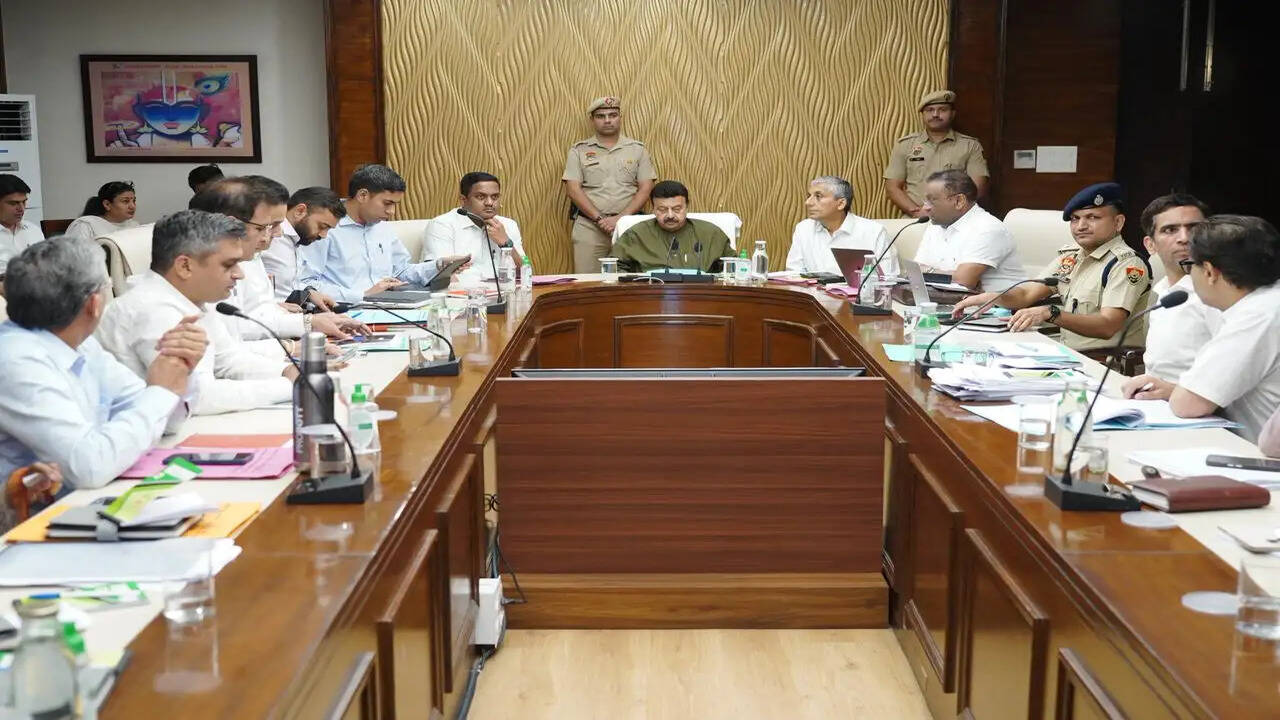
Chandigarh, May 1- Haryana Environment, Forest and Wildlife Minister Rao Narbir Singh on Friday chaired a high- level review meeting in Gurugram. The meeting reviewed air and water pollution control, solid waste management, C&D waste management, ban on single-use plastic, CETP/ETP status, green area development and implementation of environmental rules.
The Minister directed officers to implement all pollution control measures within set timelines and ensure a clean environment for the public. Senior officers, including Additional Chief Secretary, Sh. Sudhir Rajpal and Pollution Control Board officers were present in the meeting.
Reviewing the agenda, the Minister said that construction sites above 500 square yards which are not registered on the Dust Portal should be challaned on priority. He also directed strict action against registered sites that are not following rules.
During the meeting, ACS, Sh. Sudhir Rajpal informed that around 400 construction sites in Gurugram will be covered within 15 days; otherwise, challan proceedings will be initiated against the concerned. He also directed that proper barricading be installed at every site to ensure that Gurugram seen as a model city with dust pollution effectively controlled.
Haryana takes comprehensive steps to improve air quality, strengthens monitoring system
Member Secretary, Haryana State Pollution Control Board (HSPCB), Sh. Yogesh Kumar said that the Pollution Control Board informed that several steps have been taken to improve air quality. In the state, 29 Continuous Ambient Air Quality Monitoring Stations have been established in the state, while 23 new stations are being established in the NCR region. In addition, 46 manual monitoring stations and 4 testing labs are functioning.
He further said that four source apportionment studies are currently underway in the state. To control dust pollution, 22 Dust Control and Management Cells have been set up. For monitoring industrial emissions, Continuous Emission Monitoring Systems (CEMS) have been installed in 521 industries, while 875 additional industries in three sectors have also been directed to install them. Similarly, for construction site monitoring, 3,866 sites have been registered on the Dust Portal to ensure real-time monitoring.
Strict measures to control road dust pollution; Focus on Mechanised Cleaning and Water Sprinkling
During the meeting, HSPCB officers informed that extensive measures are being taken by the state government to control road dust pollution. They stated that mechanised road sweeping is being promoted in NCR municipal corporations, where 56 machines are currently operational, and 91 new machines are planned to be procured this year. In addition, 60 anti-smog guns and 160 water sprinklers are being used regularly to control dust levels. Under the City Action Plan, dust-free roads are being developed, and 1,203 km of roads have been identified in the NCR region, of which 119 km have already been redeveloped in the first quarter of 2026.
Effective steps under Yamuna Action Plan for Water Pollution Control and BOD Improvement
HSPCB officers further informed that approximately 682 MLD of wastewater is discharged into the Yamuna through drains originating from Haryana. However, it was clarified that 128.6 MLD of this wastewater enters Haryana from the Delhi region before flowing into the Yamuna. Thus, the total discharge from Haryana stands at around 553.4 MLD. Additionally, nearly 83 MLD of wastewater from Delhi’s Alipur drain is directly discharged into the Yamuna in the Faridabad region, contributing significantly to pollution.
The Cabinet Minister directed HSPCB officers to identify all such points where untreated wastewater is being discharged into drains or the Yamuna and ensure strict action against responsible individuals or entities as per rules.
Six STPs with a total capacity of 133 MLD are currently under construction and are expected to be completed by 2027
Sh. Yogesh Kumar apprised the Minister that a total of six STPs with a combined capacity of 133 MLD are being set up in the state to strengthen sewage management, with a target for completion by March 2027. He said that in Bajghera, a 2 MLD STP is nearly 85 percent complete and will be finished by June 2026. Similarly, the 3 MLD STP at Khewra in Sonipat is 45 percent complete, while the major 77 MLD project at Radaur Road in Yamunanagar has reached 30 percent progress and is scheduled for completion by March 2027.
In Panipat’s Matlauda, the 3 MLD STP is 95 percent complete, whereas the 3 MLD project at Dadlana is 55 percent complete. Besides this, a 45 MLD STP at Badshahpur in Faridabad is under construction with 15 percent progress.
He added that the completion of these projects will significantly enhance the sewage treatment capacity of the state.
Yamuna Catchment: Upgradation of 7 STPs (288.5 MLD) to Strengthen Pollution Control
In order to further strengthen the existing sewerage infrastructure in the Yamuna catchment area, upgradation work of seven STPs with a total capacity of 288.5 MLD is being undertaken. It was informed that STPs in Gohana (3 MLD), Sonaria in Sonipat (40 MLD), Line Par area in Bahadurgarh (18 MLD), and Hathin (4.5 MLD) will be upgraded as per the scheduled timeline by 2026–27. Similarly, the 3 MLD STP at Hasanpur is targeted for completion by December 2026, while the large STPs at Dhanwapur in Gurugram (100 MLD) and Behrampur (120 MLD) will be upgraded by August 2027.
He said that these upgradation works will improve both the capacity and quality of sewage treatment, thereby significantly reducing pollution load entering the Yamuna. In addition, 11 new STPs with a combined capacity of 425 MLD are also proposed at various locations in the state at an estimated cost of Rs. 1,000 crore.
Target to Reduce BOD Levels in Drains by 2027; Strict Monitoring of Industries
Rao Narbir Singh said that the Haryana Government has set a target to reduce the Biological Oxygen Demand (BOD) level in drains to below 10 mg/L by December 31, 2027. He directed officers to ensure strict monitoring of industries to prevent illegal discharge of wastewater through bypasses or tankers, and to constitute surprise inspection teams for effective enforcement.
He also instructed the strengthening of real-time monitoring systems (OMD) at ETPs, CETPs, and STPs to ensure effective implementation of pollution control measures.
Action on Single-Use Plastic: Focus on Major Stockists
The Cabinet Minister expressed concern over the enforcement of the ban on single-use plastic and said that action should focus on major stockists rather than small retail shopkeepers, so as to effectively curb its availability in the market.
HSPCB officers informed that during the special enforcement drive conducted from December 15, 2025, to April 15, 2026, around 6,863 challans were issued, fines amounting to Rs. 60,86,750 were imposed, and approximately 5,800 kg of plastic was seized and destroyed.
Strict Directions on Bandhwari Landfill, RMC Plants and Slaughterhouses; Review of City Action Plan
Rao Narbir Singh also reviewed the progress of legacy waste disposal at the Bandhwari landfill site, action against RMC plants, and compliance with environmental norms in slaughterhouses. He directed officers to expedite the scientific disposal of legacy waste, take strict action against violating RMC plants, and ensure strict compliance of environmental standards in slaughterhouses.
He further reviewed the Annual City Level Action Plan of Gurugram and emphasised effective implementation of all measures to ensure pollution control and environmental protection.