
Haryana’s Progress and People’s Prosperity Are Our Shared Goal- Chief Minister


Political Ideologies May Differ, but We Are All Representatives of the People of Haryana, Says Nayab Singh Saini
Chief Minister Calls Upon Public Representatives to Uphold the Dignity of the Assembly, Strengthen Public Dialogue and Reflect Constitutional Values in Their Conduct
Addresses Inaugural Session of ‘Janpratinidhi Sammelan’
Chandigarh, November 2
Haryana Chief Minister Sh. Nayab Singh Saini said that public representatives may follow different political paths and ideologies, but Haryana’s progress and the prosperity of its people remain their shared goal. What unites them is their identity as representatives of the people of Haryana. He said public representatives have a responsibility to understand the aspirations and needs of the people and contribute to the state’s development.
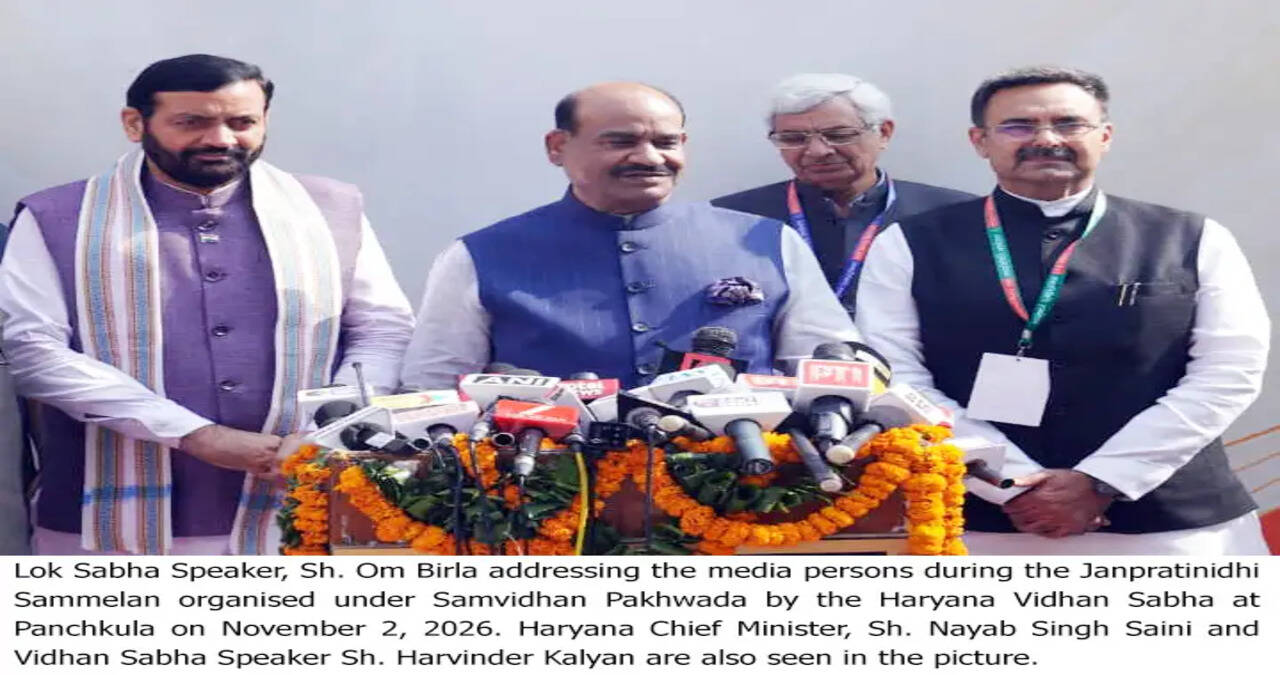
The Chief Minister was addressing the inaugural session of the ‘Janpratinidhi Sammelan’, organised by the Haryana Vidhan Sabha at Panchkula today as part of the Samvidhan Pakhwada Programme.
He said Haryana had completed 60 years of its formation. Congratulating the people of the state on its Diamond Jubilee, he said the conference provided an opportunity to draw inspiration from the state’s glorious past and chart the course for its future.
The Chief Minister said the presence of Lok Sabha Speaker Sh. Om Birla had added to the significance of the ‘Janpratinidhi Sammelan’. His guidance on parliamentary procedures, the dignity of the House and the responsibilities of public representatives is valuable to all. He also recalled that President Smt. Droupadi Murmu had graced Haryana’s Diamond Jubilee celebrations and bestowed her blessings upon the people of the state.
The Chief Minister said Haryana’s 60-year development journey is not merely a story of expanding roads, institutions and industries, but also reflects the hard work of farmers, labourers, women, youth and ordinary citizens.
From green fields to industrial achievements, from village pathways to modern expressways, and from traditional wrestling arenas to international sporting platforms, Haryana had written new chapters of progress through hard work, courage and determination. The foundation of the state’s achievements had also been laid through discussions, decisions and legislation shaped by public representatives in the Vidhan Sabha.
The Chief Minister said Haryana came into existence on November 1, 1966, when the Legislative Assembly had 54 members. The number of Assembly seats increased to 81 in 1967 and subsequently to 90 in 1977.
He said there is now a need to increase the number of Assembly seats to ensure wider public participation and make more facilities accessible to the people.
The Chief Minister said Haryana is now carrying forward its democratic journey through the 15th Legislative Assembly. These figures reflected the expansion of representation and the growing aspirations of the people.
He recalled that the first sitting of the Haryana Vidhan Sabha was held on December 6, 1966. Resources were limited at the time, and expanding basic facilities such as education, healthcare, drinking water, irrigation, electricity, roads and administrative infrastructure posed major challenges.
He expressed gratitude to all public representatives who had worked under those circumstances to lay a strong foundation for Haryana’s future.
Constitutional Values Must Be Reflected in Decisions and Conduct
The Chief Minister said respect for the Constitution must be reflected in decisions and conduct. The Preamble embodies the ideals of justice, liberty, equality and fraternity, and public representatives have a responsibility to translate these ideals into governance.
He said constitutional values were strengthened when eligible citizens received their rights without discrimination, the concerns of vulnerable people were heard, and mutual respect increased in society.
The Chief Minister said the Vidhan Sabha is an important forum for making laws, approving the use of public funds and holding the government accountable.
A meaningful question raised in the House could help resolve a village’s problem, while a constructive suggestion on a Bill could improve the lives of lakhs of citizens.
Question Hour, Calling Attention motions, budget discussions and the work of legislative committees kept the parliamentary system vibrant. Effective use of these processes required study, preparation and continuous engagement with the people, he said.
Differences of Opinion Must Not Undermine the Dignity of the House
The Chief Minister said accountability strengthened governance. Listening seriously to issues of public interest raised by the Opposition is a democratic responsibility. Similarly, offering practical suggestions alongside criticism is an important service in public life.
He said debates in the House could be intense, but the dignity of language must always be maintained. Public representatives should challenge one another’s views through reasoned arguments and strengthen public confidence in democracy and the Constitution through their conduct.
Sh. Nayab Singh Saini said citizens could now instantly observe the words and conduct of public representatives through digital platforms. The younger generation, in particular, learnt from them how differences of opinion should be expressed in public life. It is therefore essential to verify facts, avoid personal attacks and use responsible language when referring to constitutional institutions. Once elections were over, a public representative represented the entire constituency, he said.
Take Constitutional Awareness Beyond Conference Halls to Villages and Educational Institutions
The Chief Minister said ‘Janpratinidhi Sammelan’ would become more meaningful when discussions extended beyond conference halls to villages, schools and residential communities.
Citizens should be informed in simple language about the functioning of the Vidhan Sabha, the legislative process, budget priorities and the ways in which public grievances could be raised.
He said people must also be made aware of their fundamental duties alongside their rights. Protecting public property, respecting women, conserving the environment and maintaining social harmony should become part of everyday life.
The Chief Minister urged serving and former MLAs to organise dialogues on the Constitution with young people in their respective constituencies.
Initiatives such as Youth Parliaments, readings of the Preamble and discussions on local issues should be organised in schools and colleges. These activities would help students understand the functioning of the Vidhan Sabha and the values enshrined in the Constitution while strengthening their faith in democracy.
Public Participation Essential for Building a Developed Haryana
The Chief Minister said public participation is essential for building a Viksit Haryana. People living in an area understand its needs better than anyone else. Therefore, the voices of women, farmers, labourers, youth, entrepreneurs and disadvantaged sections must be heard while determining development priorities.
He said public representatives should serve as an effective bridge of communication between the government and society. When citizens participated in planning, their involvement in implementation and protection of public resources also increased.
The Chief Minister said Haryana’s role in building a developed India by 2047 must be shaped from now onwards.
This requires serious efforts to advance quality education, skills, employment, modern agriculture and better healthcare services, along with water conservation, a clean environment and balanced urban development.
Opportunities arising from new technologies must reach every section of society, and the benefits of development must extend to both villages and cities. Along with prosperity, social trust and the dignity of citizens must also grow, he said.
Chief Minister Calls for Collective Resolve to Strengthen Democracy
The Chief Minister said the legacy public representatives should leave behind is a Haryana where opportunities were available to all, every citizen is treated with dignity, and public confidence in democracy continues to grow.
He said future generations would ask what those entrusted with decision-making powers had done for them. The answer to that question must be reflected in their work.
He called upon all public representatives to resolve to enhance the dignity of the House, strengthen dialogue with the people and uphold constitutional values through their conduct.