
Gram Sabhas to lead transparent verification of welfare beneficiaries across Haryana*

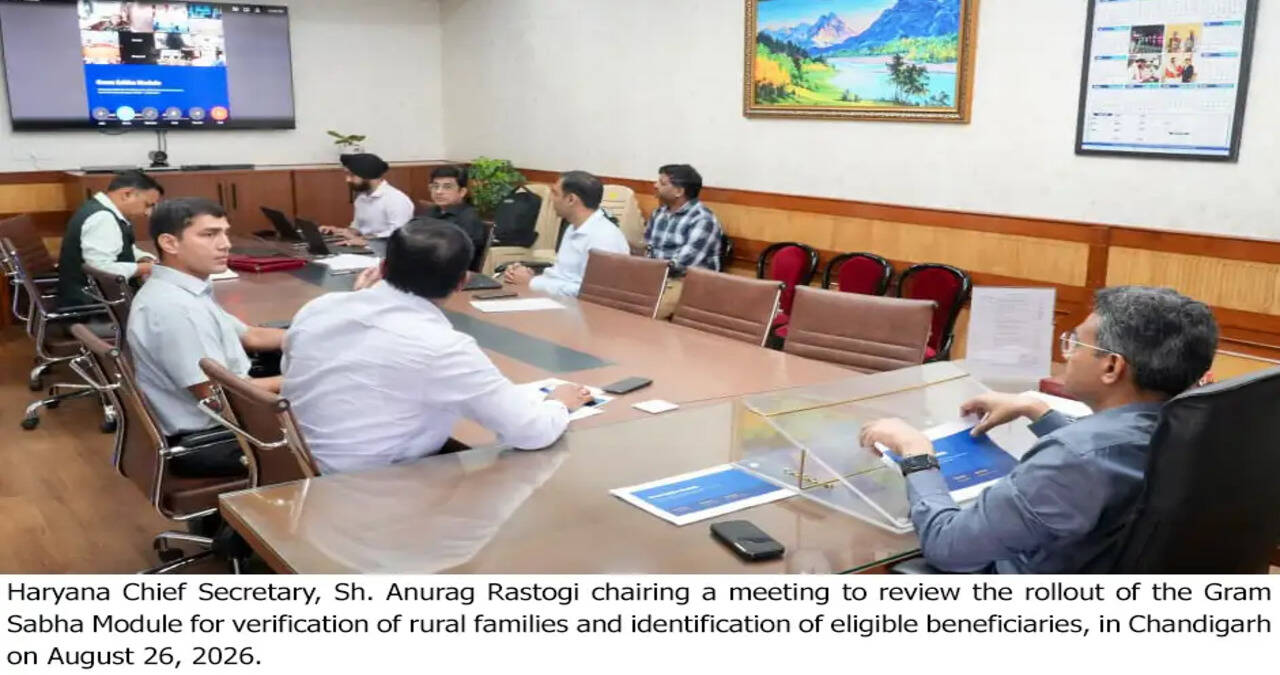

*Chief Secretary Anurag Rastogi reviews ambitious field exercise aimed at ensuring that benefits reach eligible beneficiaries*
Chandigarh, August 26: Haryana has launched a major grassroots exercise to make identification of eligible beneficiaries more accurate, transparent and people-centric, with Chief Secretary Sh. Anurag Rastogi chairing a high-level meeting to review the rollout of the Gram Sabha Module for verification of rural families.
The initiative places the Gram Sabha at the centre of the verification process, bringing government welfare data closer to the ground and giving village communities a direct role in establishing the actual status of families. The exercise is aimed at ensuring that government assistance and welfare benefits are directed to deserving households on the basis of verified field-level information.
Commissioner and Secretary, CRID, Sh. J Ganesan informed that the Gram Sabha Module has been developed to undertake a comprehensive assessment of rural households covering family structure, Antyodaya Anna Yojana (AAY) beneficiaries, family income, ‘kachhi chhat’ status and occupation profiles. The integrated approach is expected to provide a more reliable picture of the socio-economic status of families and strengthen the delivery of welfare schemes.
He said the initiative has already shown encouraging results. As many as 1,309 families have been verified through 166 Gram Sabhas across 13 of the state's 23 districts, reflecting the administration's growing capacity to conduct structured verification at the grassroots level.
The exercise follows a decision to verify pending cases through Gram Sabhas after approximately 1.66 lakh families requiring income verification were identified. Subsequently, the scope was strengthened to include rural families with annual income below Rs 1.8 lakh, with such cases being placed before the respective Gram Sabhas for determination of the appropriate income range.
Under the system, verification will be carried out in a clearly defined sequence. Gram Sabhas will first establish family structure, followed by confirmation of AAY beneficiaries and verification of families with income below Rs 1.8 lakh. The exercise will also physically verify ‘kachhi chhat’ status, supported by photographs with a family member, while the occupation category of each earning member will be recorded.
The government has simultaneously created a robust supervisory mechanism to maintain the quality of the exercise. CEOs of Zila Parishads, ADCs, Gazetted Officers, CRID officials and Gram Sachivs have been assigned specific responsibilities.
A dedicated training programme is being put in place to ensure smooth implementation. DCRIM officials will receive training through a video conference on August 27, after which they will work as master trainers for field officials in their respective districts. ADCs will supervise the training cascade to ensure that officials are adequately prepared before field-level implementation.
The next phase of the exercise is scheduled to commence shortly, with the Gram Sabha process targeted for completion by September 28 and the first phase of the exercise by October 2, 2026.
The initiative represents a significant step towards data-driven, participatory and transparent governance in rural Haryana. By combining digital records with physical verification and the collective scrutiny of Gram Sabhas, the state is building a stronger mechanism to identify genuine beneficiaries, improve the accuracy of welfare databases and ensure that the benefits of government schemes reach the families for whom they are intended.
Additional Secretary, Citizen Resources Information Department, Sh. Shashvat Sangwan, and other senior officers were present in the meeting while all Deputy Commissioners and CEOs of Zila Parishads joined via videoconferencing.