
From Litigation to Reconciliation: National Lok Adalat Gives Matrimonial Dispute a Happy Ending*
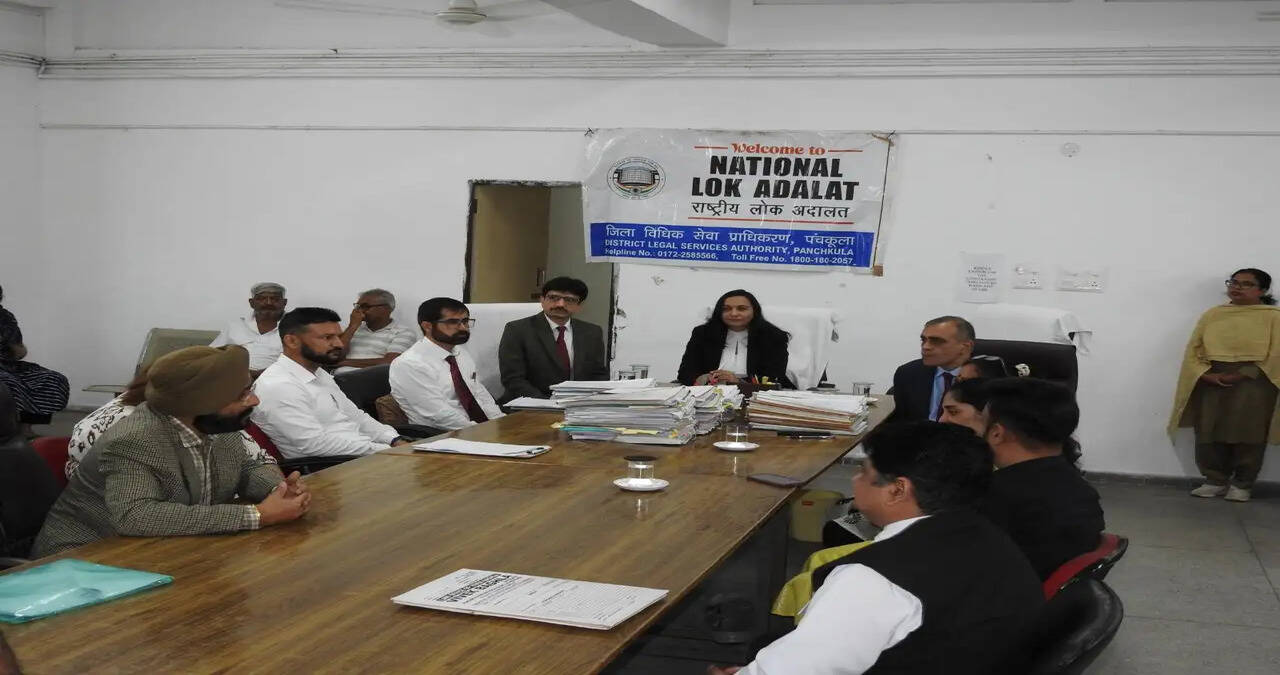

Chandigarh, September 12- The 3rd National Lok Adalat of the year was organised across the State of Haryana under the dynamic leadership and guidance of Justice Harsimran Singh Sethi, Judge, Punjab & Haryana High Court and Executive Chairman, Haryana State Legal Services Authority (HALSA). The National Lok Adalat was conducted across all 22 Districts and 38 Sub-Divisions of Haryana.
Today’s National Lok Adalat witnessed an unprecedented response and marked a historic milestone, recording the highest ever figures in terms of cases settled. More than 6,75,000/- cases were amicably disposed of.
A heartwarming example of the transformative potential of Lok Adalat emerged from Hisar, where a long-standing matrimonial dispute between the parties, pending before the Family Court, Hisar, was amicably resolved through mutual consent. Through the sincere intervention and counselling efforts of the Lok Adalat Bench, the parties were encouraged to resolve their differences and restore harmony in their relationship. The matter was settled on the very day of the National Lok Adalat. In a touching gesture, both parties fed sweets to each other and expressed their willingness to resume their family life together with mutual understanding and harmony. The settlement exemplifies how the National Lok Adalat can go beyond mere disposal of cases and, through dialogue, counselling, reconciliation and mutual consent, restore relationships, preserve families and bring renewed hope and peace to the lives of litigants.
As a symbolic gesture towards the National Lok Adalat and with a view to promoting environmental consciousness and sustainable development, Justice Harsimran Singh Sethi planted a sapling at the Administrative Building of HALSA, Panchkula.
On the day of the National Lok Adalat, Justice Harsimran Singh Sethi virtually interacted with some of the Lok Adalat Benches across the State and reviewed the proceedings. Justice Sethi emphasized that sincere and concerted efforts should be made to facilitate the amicable settlement of disputes through mutual consent, meaningful dialogue, reconciliation and compromise.
Thereafter, Justice Harsimran Singh Sethi visited the District Courts, Panchkula and personally inspected the Lok Adalat Benches and interacted with the litigants and reviewed the proceedings of Lok Adalat Benches.
The substantial disposal achieved during the National Lok Adalat was the result of the concerted efforts and continuous guidance of the Executive Chairman, HALSA, who had been consistently encouraging the Chairpersons and Secretaries of the District Legal Services Authorities, to take all necessary measures for the successful conduct of the National Lok Adalat including identification of suitable cases, pre-Lok Adalat sittings, effective coordination with stakeholders, maximum public awareness etc. Prior to the National Lok Adalat, Justice Sethi also held video conferencing with the Chairpersons and Secretaries of the District Legal Services Authorities and other judicial officers, reviewing the preparedness and progress and motivating them to demonstrate the highest level of commitment, efficiency and dedication and to make every possible endeavour to facilitate amicable settlements.
The National Lok Adalat, including pre-Lok Adalat sittings, witnessed substantial disposal of cases involving a wide variety of disputes. The massive response received from litigants reflected growing public faith in the mechanism of Lok Adalat as an effective mode of alternative dispute resolution. The settlements arrived at during the Lok Adalat not only saved valuable time and litigation expenses of the parties but also substantially contributed towards reducing pendency of cases in courts across Haryana. An amount of approximately Rs.78,44,79,92,903 was also disbursed/awarded during the National Lok Adalat.
For effective conduct of the National Lok Adalat, a total of 184 Benches were constituted across the State to take up both pre-litigation and pending matters including civil disputes, matrimonial cases, motor accident claim cases, bank recovery matters, cheque bounce cases under the Negotiable Instruments Act, traffic challans, compoundable criminal offences.