
45 Lakh People to Benefit from Rs. 5,714-Crore World Bank-Funded Water Secure Haryana Programme
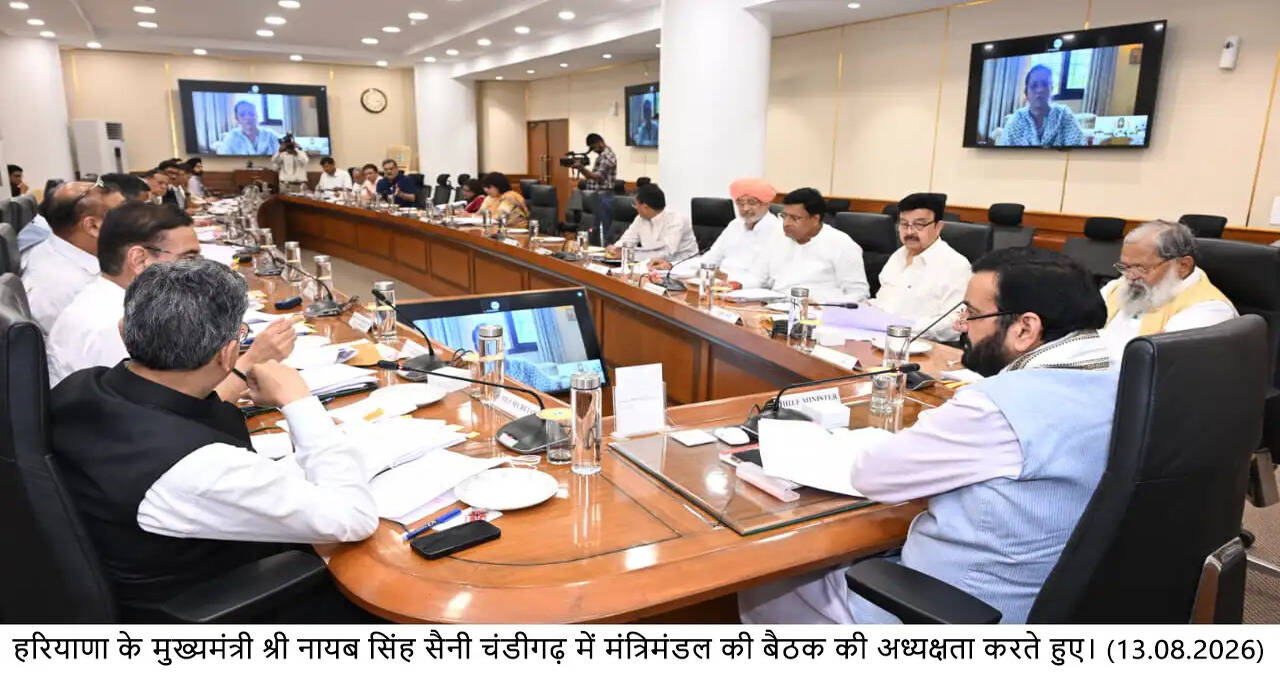
Chandigarh, August 13 — In a major step towards securing Haryana’s water future and strengthening the State’s resilience to climate-related challenges, the Haryana Cabinet, chaired by Chief Minister Sh. Nayab Singh Saini, here today, approved the World Bank-funded Water Secure Haryana Programme (WSHP) at an estimated cost of Rs. 5,714.80 crore. The integrated water-sector programme, designed to address groundwater depletion, irrigation efficiency, water availability and sustainable agricultural water use, is expected to directly benefit approximately 45 lakh people across the priority irrigation clusters. The programme comprises a World Bank loan of Rs. 4,000.36 crore and a State Government share of Rs. 1,714.44 crore.
The programme will cover 15 priority irrigation clusters, encompassing 48.94 lakh acres of irrigable Command Area, and will involve the Irrigation & Water Resources Department (I&WRD), Micro Irrigation & Command Area Development Authority (MICADA), and the Agriculture & Farmers Welfare Department.
Programme to Strengthen Long-Term Water Security and Climate Resilience
The WSHP is expected to make a significant contribution towards ensuring the State’s long-term water security and strengthening its climate resilience. The programme will improve the efficiency and reliability of canal irrigation, reduce conveyance losses and help lower groundwater extraction. It will also augment water availability through groundwater recharge and reuse of treated wastewater, while promoting greater adoption of micro-irrigation and facilitating the reclamation of waterlogged areas.
Measures such as Direct Seeded Rice (DSR) and crop diversification will help reduce agricultural water demand. The deployment of SCADA and RTDAS systems will enable real-time monitoring of canal systems and water resources, thereby improving operational efficiency and decision-making.
The programme will further strengthen institutional capacity and water governance and enhance the resilience of agricultural incomes.
WSHP is designed as an integrated water-sector programme rather than a conventional construction project
Notably, Haryana’s water resources are under increasing pressure due to declining groundwater levels and over-exploitation in several areas, increasing dependence on groundwater irrigation, ageing canal infrastructure and conveyance losses, water-logging and salinity, rising energy requirements for groundwater pumping, and increasing irrigation demand coupled with the need for crop diversification. Accordingly, the WSHP has been designed as an integrated water-sector programme rather than a conventional construction project.
Major Investments to Modernise Irrigation Infrastructure and Improve Water-Use Efficiency
Under the Irrigation & Water Resources Department (I&WRD), the Water Secure Haryana Programme provides for a comprehensive set of interventions to modernise irrigation infrastructure, augment water availability and strengthen digital water management. Canal modernisation will include the rehabilitation of 104 canal channels at an estimated cost of Rs. 2,484.87 crore, covering approximately 8.75 lakh acres of Command Area (CCA).
The intervention will include rehabilitation, lining and associated improvement works aimed at reducing conveyance losses and improving the reliability and efficiency of irrigation services. In addition, 131 new water bodies will be constructed at an estimated cost of Rs. 248 crore, primarily to enhance groundwater recharge.
The programme also envisages the reuse of treated wastewater from four Sewage Treatment Plants (STPs) at an estimated cost of approximately Rs. 282.13 crore, thereby augmenting the availability of water for irrigation. As part of digital water management, 20 SCADA locations will be deployed for automated and real-time canal operation, along with 400 RTDAS locations/measurement points for real-time monitoring of discharge and water flow. These measures are aimed at enabling evidence-based canal operations, improving water accounting and enhancing transparency and efficiency in water management.
MICADA and Agriculture Interventions to Reduce Water Demand and Strengthen Farm Resilience
Under the Micro Irrigation & Command Area Development Authority (MICADA), the programme provides for the rehabilitation of 620 watercourses at an estimated cost of approximately Rs. 900 crore, besides 120 canal-based micro-irrigation projects at an estimated cost of approximately Rs. 600 crore.
Meanwhile, under the Agriculture & Farmers’ Welfare Department, the programme envisages the reclamation of approximately 2 lakh acres of waterlogged land through Vertical Drainage/Sub-Surface Drainage, promotion of Direct Seeded Rice (DSR) over approximately 5 lakh acres, and crop diversification under the MeraPaniMeriVirasat (MPMV) scheme over approximately 1.12 lakh acres.
Together, these interventions are aimed at reducing agricultural water demand, improving irrigation efficiency and enhancing the resilience and sustainability of farmers’ incomes.