
Use Treated Water Scientifically and in a Planned Manner- CM

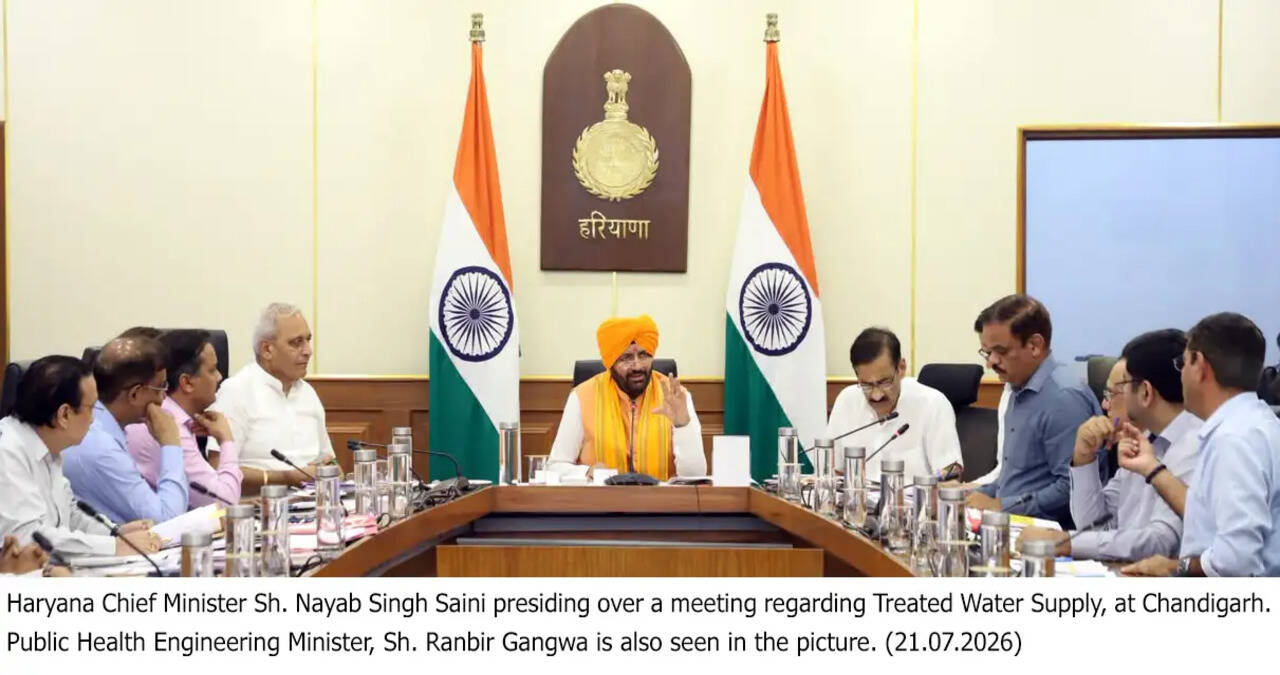
Chandigarh, July 21- Haryana Chief Minister, Sh. Nayab Singh Saini said that water conservation is the need of the hour and that the scientific and planned use of treated water can significantly reduce pressure on groundwater and drinking water sources while ensuring the long-term availability of water for industries, the energy sector, green spaces and agriculture.
Chairing a special review meeting on the Reuse of Treated Wastewater (TWW) Policy held late Monday evening, the Chief Minister directed officers to ensure that all Sewage Treatment Plants (STPs) and Common Effluent Treatment Plants (CETPs) in the state produce treated water strictly in accordance with prescribed standards and that its optimum utilisation is ensured. Public Health Engineering Minister, Sh. Ranbir Gangwa also remained present during the meeting.
The Chief Minister said treated water should not go to waste under any circumstances. He directed the officers concerned to develop a robust and well-planned distribution network so that it can be supplied efficiently to thermal power plants, green belts, agriculture and other sectors requiring water.
Officers of the Public Health Engineering Department informed that the Irrigation and Water Resources Department has prepared a phased plan to promote the reuse of treated wastewater. In the first phase, a Rs. 500-crore project covering 35 STPs across 21 districts was prepared and approved under NABARD. Of these, 27 STPs have been finalised for the reuse of treated wastewater through micro-irrigation. Work has already been completed on 19 STPs, while work on the remaining eight is in progress. The project aims to benefit nearly 40,000 acres of agricultural land.
The Officers further informed that 57 STPs have been included in the second phase, comprising 13 STPs with a combined capacity of 157.50 MLD and 44 STPs with a combined capacity of 370.75 MLD. At present, Haryana has 207 STPs/CETPs, and the remaining treatment plants will also be brought under the programme in a phased manner.
Furthermore, efforts are underway to complete all first-phase projects on schedule, develop technically viable STPs under the second phase and integrate the remaining STPs into the programme. The objective under the Vision@2047 roadmap is to ensure 100 per cent reuse of treated wastewater generated in the state by March 2031.
Comprehensive mapping of STPs and CETPs
The Chief Minister directed that all STPs and CETPs across the state be comprehensively mapped. A detailed profile should be prepared for every plant, including its treatment capacity, quantity of treated water generated, potential utilisation and the infrastructure required to supply water to nearby areas.
He said systematic planning and better inter-departmental coordination would enable large-scale utilisation of treated water while reducing dependence on groundwater and potable water sources.
The Chief Minister directed that the use of treated water should first be prioritised for thermal power plants, followed by green belts, parks, plantations and agriculture. He also directed that a separate plan be prepared for industrial areas to encourage industries to replace freshwater with treated water wherever feasible.
Departments to work in close coordination
The Chief Minister directed that the entire system be streamlined through coordinated efforts rather than functioning in isolation. He directed the Public Health Engineering Department, Irrigation Department, Urban Local Bodies Department, Industries Department, Energy Department, and the Haryana State Pollution Control Board to jointly prepare a comprehensive action plan.
Meanwhile, the senior officers of all concerned departments have been directed to hold regular review meetings and ensure close monitoring of the implementation process.
Inspection of STPs in residential colonies
The Chief Minister said that STPs installed in residential society colonies across the state would also undergo special inspections. Joint inspections will be conducted by officers of the Haryana State Pollution Control Board along with the concerned Municipal Corporations, Municipal Councils and Municipal Committees.
He directed that treated water generated from STPs in private residential colonies should be utilised for green belts, parks and plantation within the colonies. Where such utilisation is not possible, suitable pipelines or other distribution networks should be created to supply the water to agricultural fields or other areas requiring it. The state has nearly 678 residential society colonies, all of which will be reviewed in a phased manner, said the Chief Minister.
Cluster-based supply system for treated water
The Chief Minister directed the Irrigation Department to develop a cluster-based distribution system for treated water. In areas having multiple STPs, these should be interconnected to establish an efficient distribution network so that the benefits of treated water reach the maximum possible area.
Solar power systems to be installed
The electricity costs involved in operating STPs were also reviewed. The Chief Minister directed that as many STPs as possible should be equipped with solar power systems under the Kusum Scheme to reduce electricity expenditure and ensure uninterrupted functioning of the plants.
He further directed that all treatment plants should remain operational round the clock, and agencies responsible for maintenance must ensure that there is no negligence in their upkeep or functioning.
Detailed booklet for every treatment plant
The Chief Minister directed officers to prepare a comprehensive booklet covering all STPs and CETPs in the state. The booklet will include the location and address of each plant, treatment capacity, daily volume of water treated, quantity of treated water available, contact details of the concerned officers, and details of the existing as well as proposed utilisation of treated water. This database, he said, would facilitate future planning and effective monitoring.
No STP should remain non-functional
The Chief Minister emphasised that no STP in the state should remain non-operational. If any plant faces issues related to electricity, maintenance, technical faults or any other operational constraints, the concerned department must resolve them immediately.
He also directed that electricity expenditure and other operational requirements of STPs should be reviewed regularly to ensure uninterrupted functioning. Any negligence in this regard, he warned, would invite strict action.
Treated water to reach thermal power plants
The Chief Minister directed officers to connect nearby STPs with thermal power plants through dedicated pipeline networks to ensure a regular supply of treated water. This, he said, would substantially reduce the use of freshwater by thermal power plants, allowing the conserved water to be utilised for other essential purposes.
He also directed that industrial areas across the state be comprehensively mapped to identify which industries can be supplied treated water from nearby STPs or CETPs and the infrastructure required for such supply. He emphasised that treated water should be accorded priority for industrial use in the future.
Detailed reports sought within 15 days
The Chief Minister directed that all concerned departments will have to submit detailed reports to the Public Health Engineering Department within 15 days, covering their treatment capacity, availability of treated water, its present utilisation, future requirements and the proposed distribution mechanism. Based on these reports, a comprehensive state-wide action plan will be prepared to maximise the reuse of treated wastewater.
Chief Principal Secretary to Chief Minister, Sh. Rajesh Khullar, Additional Chief Secretary, Irrigation and Water Resources Department, Sh. Anurag Agarwal, Principal Secretary, Public Health Engineering Department, Sh. Pankaj Yadav, Commissioner and Secretary, Urban Local Bodies Department, Sh. Ashok Meena, Chairman, Haryana State Pollution Control Board, Sh. Vinay Pratap Singh, Deputy Principal Secretary to Chief Minister, Dr. Yashpal, Managing Director, Haryana Tourism Corporation Limited, Sh. Parth Gupta, Municipal Commissioner, Gurugram, Sh. Pradeep Dahiya, OSD to Chief Minister, Sh. Virender Badhkhalsa and Engineer-in-Chief (EIC), Sh. Devender Dahiya also remained present during the meeting.